

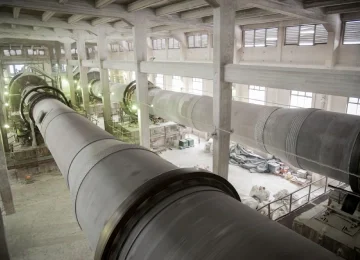
Production of Calcined alumina
Further calcination in a counter-current rotary kiln at temperatures between 1200 and 1500 °C effects a transformation to the most thermodynamically stable crystalline structure called alpha or α-Al2O3. The degree of calcination or the proportion of the alpha structure affects the final properties of the alumina. These are usually expressed as particle size distribution, specific surface area, phase composition, primary crystal size and chemical purity. Fully calcined alumina consists predominantly (> 99%) of alpha-alumina, which has exceptional mechanical and thermal properties.
The preparation of the feedstock enables the diversification of the products according to chemical properties. Different calcination degrees are used to produce SALOX® products, which differ in terms of their α-Al2O3 content, primary crystal size, the content of impurities, particularly sodium, and the morphology of the material, which consequently leads to differences in the specific surface area of the products. Grinding and separation techniques are used to make a wide range of end products with different particle size distributions.
Properties of Calcined alumina
- High purity: the Al₂O₃ content typically exceeds 99%.
- High hardness: comparable to corundum (9 on the Mohs hardness scale), which makes it ideal for abrasive applications.
- Thermal stability: withstands extremely high temperatures, making it ideal for refractory materials.
- Chemical inertness: resistant to acids and bases, ensuring a long lifetime in harsh environments.
- Controlled particle size: available in different sizes for specific applications.
- Controlled specific surface area: can be adjusted to improve reactivity or inertness.
Its properties make calcined alumina a useful material in a number of industries, the most common of which are:
Refractory Materials
The unique properties of alumina make it one of the most commonly used oxides in the refractory industry. It is a component of various types of concrete, bricks, monoliths, insulation materials and other products.
Learn more
Ceramics
In the ceramics industry, calcined alumina is used as a component in products and in glazes. Due to its excellent insulating properties, special types of alumina with low alkali content are used in the manufacturing of electroceramics.
Learn more
Abrasives
Thanks to its hardness, calcined alumina is an essential ingredient in abrasives and polishes, ensuring the durability and performance of these products. The degree of calcination, the agglomerate content and the primary crystal size determine the effects such as scoring, smoothing and surface polishing.
Electrical and electronic components
Due to its dielectric properties, calcined alumina is used in insulators, substrates and semiconductors.
Catalysts and catalyst supports
Thanks to its high specific surface area and thermal stability, calcined alumina is used as a component of catalysts used in the petrochemical and environmental industries.
Glass and glazes
In glass and glaze manufacture, calcined alumina is used to enhance mechanical strength and hardness, which increases the resistance of glass and glazes and improves thermal and optical properties of glass, such as opacity.
Paints, coatings, polymers and other applications
Calcined alumina is used as a functional filler to improve the durability, scratch resistance and UV-stability of coatings and paints. It is used in high-performance composite materials to improve their mechanical strength and thermal stability.
As a renowned producer of specialized alumina, we are committed to ensuring that our calcined alumina meets the highest quality standards. Our production capacities and stringent quality control system guarantee the stability, quality and purity of materials, as well as give us the ability to customize specifications to suit different industrial requirements.
Calcined alumina SALOX® is available in a variety of quality grades tailored to specific industrial applications. The products vary in chemical purity, particularly in terms of their sodium content, and range from standard alkaline (Na2O approx. 0.3 wt.%), to moderately alkaline (MS, Na2O < 0.2 wt.%), low alkaline (LS, Na2O < 0.1 wt.%), and very low alkaline (VLS, Na2O < 0.05 wt.%) varieties. They also differ in terms of the degree of calcination, the proportion of the alpha phase, and consequently, the specific surface area, as determined using the B.E.T. method. The materials are available in different granulation compositions and purity levels.
Unground Calcined Aluminas SALOX®
| Type of Product | MS 100 | LS6 | VLS6 | |
|---|---|---|---|---|
| Al2O3 | % | min. 99.3 | min. 99.7 | min. 99.7 |
| Na2Ototal | % | max. 0.20 | max. 0.10 | max. 0.05 |
| Fe2O3 | % | max. 0.05 | max. 0.05 | max. 0.05 |
| SiO2 | % | max. 0.05 | max. 0.05 | max. 0.05 |
| Specific surface area (BET) | m2/g | 75 | 6 | 6 |
| Primary crystal size | µm | – | – | – |
| Average particle size d50 | µm | 80 | 80 | 80 |
| Bulk density | kg/m3 | 1000 | 1100 | 1100 |
| Type of Product | M-1 | M-MS1 | M-LS1 | M-VLS1 | |
|---|---|---|---|---|---|
| Al2O3 | % | min. 99.3 | min. 99.3 | min. 99.7 | min. 99.7 |
| Na2Ototal | % | max. 0.40 | max. 0.20 | max. 0.10 | max. 0.05 |
| Fe2O3 | % | max. 0.05 | max. 0.05 | max. 0.05 | max. 0.05 |
| SiO2 | % | max. 0.05 | max. 0.05 | max. 0.05 | max. 0.05 |
| Specific surface area (BET) | m2/g | 0.4 | 0.5 | 0.6 | 0.6 |
| Primary crystal size | µm | 3.5 | 3 | 2.5 | 2 |
| Average particle size d50 | µm | 70 | 70 | 70 | 70 |
| Bulk density | kg/m3 | 800 | 800 | 900 | 900 |
Ground Calcined Aluminas SALOX®
| Type of Product | M-1FG | M-MS1FG | M-VLS1 FG | |
|---|---|---|---|---|
| Al2O3 | % | min. 99.3 | min. 99.7 | min. 99.7 |
| Na2Ototal | % | max. 0.40 | max. 0.20 | max. 0.05 |
| Fe2O3 | % | max. 0.05 | max. 0.05 | max. 0.05 |
| SiO2 | % | max. 0.05 | max. 0.05 | max. 0.05 |
| Loss on ignition (L.O.I.) | % | 0.30 | 0.30 | 0.30 |
| Specific surface area (BET) | m2/g | max. 1.5 | max. 1.5 | max. 1.5 |
| Primary crystal size | µm | 2.5 – 4.0 | 1.5 – 2.5 | 1.5 – 2.5 |
| Average particle size d50 | µm | 5 | 5 | 5 |
| + 45 µm sieve | % | max. 3 | max. 3 | max. 3 |
| Bulk density | kg/m3 | 850 | 850 | 850 |
| Type of Product | M-1SG | M-VLS1SG | M-VLS1SG3 | |
|---|---|---|---|---|
| Al2O3 | % | min. 99.3 | min. 99.7 | min. 99.7 |
| Na2Ototal | % | max. 0.40 | max. 0.05 | max. 0.05 |
| Fe2O3 | % | max. 0.05 | max. 0.05 | max. 0.05 |
| SiO2 | % | max. 0.05 | max. 0.05 | max. 0.05 |
| Loss on ignition (L.O.I.) | % | 0.30 | 0.30 | 0.30 |
| Specific surface area (BET) | m2/g | max. 1.5 | max. 1.5 | max. 1.5 |
| Primary crystal size | µm | 2.5 – 4.0 | 2.5 – 4.0 | 1.5 – 2.5 |
| Average particle size d50 | µm | max. 4 | max. 4 | max. 3 |
| + 45 µm sieve | % | max. 3 | max. 3 | max. 2 |
| Bulk density | kg/m3 | 850 | 850 | 800 |
Reactive Calcined Aluminas SALOX®
| Type of Product | M-VLS1R | M-S1R | M-S1RS1 | |
|---|---|---|---|---|
| Al2O3* | % | min. 99.6 | min. 99.5 | min. 99.5 |
| Na2Ototal | % | max. 0.05 | max. 0.30 | max. 0.30 |
| Fe2O3 | % | max. 0.06 | max. 0.06 | max. 0.06 |
| SiO2 | % | max. 0.08 | max. 0.08 | max. 0.08 |
| CaO | % | max. 0.06 | max. 0.06 | max. 0.06 |
| Specific surface area (BET) | m2/g | 1.6 | 1.6 | 2.0 |
| Average particle size d50 | µm | 2 | 2 | 1.7 |
| Average particle size d90 | µm | max. 9 | max. 6 | max. 6 |
| Bulk density | kg/m3 | 820 | 820 | 800 |