

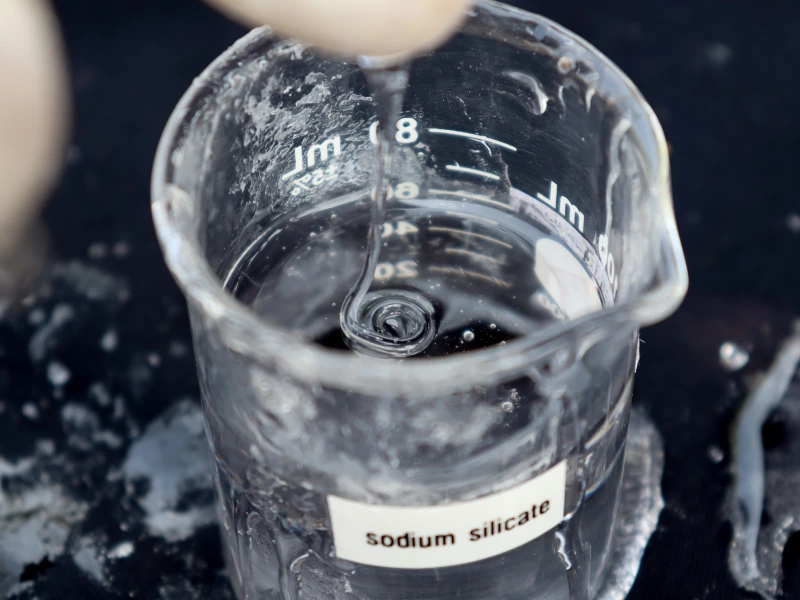
Sodium water glass in liquid form is a silicate material dissolved in an alkaline sodium solution. It has the same properties as glass, but is also soluble in water due to due to its high alkalinity. It is produced by dissolving silica sand or solid water glass crystals.
Production of Silicates
- High purity: the Al₂O₃ content typically exceeds 99%.
- High hardness: comparable to corundum (9 on the Mohs hardness scale), which makes it ideal for abrasive applications.
- Thermal stability: withstands extremely high temperatures, making it ideal for refractory materials.
- Chemical inertness: resistant to acids and bases, ensuring a long lifetime in harsh environments.
- Controlled particle size: available in different sizes for specific applications.
- Controlled specific surface area: can be adjusted to improve reactivity or inertness.
Detergent industry
In the detergent industry, water glass is used as an alkaline buffer, emulsifier, salt deflocculant, anti-corrosive agent, water softener and surfactant.
Chemical industry
Water glass is used as a source of SiO2 for synthesizing salts, gels and precipitated silicates. It can also be used as a properties-enhancing agent (TiO2, plastics, paints, varnishes, etc.).
Foundry industry
Water glass is used as a binder for hardening foundry cores as it is a simple, inexpensive and effective solution when added to sand.
Refractory panels
Water glass is used as a binder and fire retardant in light, non-combustible thermal insulation panels for use in trains, planes and boats.
Refractory putties
Adding water glass improves the thermostability of refractory putties and increases their expansion, improving the seal between construction elements upon installation.
Binders
Water glass is used as a binder in the paper, textile, cardboard (packaging), construction (grinding wheels) and other industries.
Terrain fortification and stabilization
Water glass is used to fortify and stabilize sandy terrain, which is necessary in the construction of roads, tunnels, channels or dams. It is also used for stabilizing landslides.
Waste and water treatment
Water glass is used for waste stabilization primarily for various types of toxic dust (including radioactive dust) and sludge (where it is used to solidify or dry the sludge faster). It makes the waste more suitable for transport and storage.
Cement
Water glass is used as an additive in acid-resistant and firm cements. Using water glass increases the thermostability, melting point and hardness of cement, and improves its waterproofing and corrosion resistance.
Minerals and ceramics
Water glass is used as a deflocculant in clay suspensions to prevent their settling and ensure uniform application. In inorganic technology, water glass is used to reduce the viscosity of suspensions.
Oil industry
Water glass is used as an emulsifier in oil purification.
Other applications of water glass
Water glass is used in polishing pastes and wood varnishes, to control dust on gravel roads, to seal cracks in concrete sewage pipes, to improve the efficiency of vegetable oil extraction and more.
| Type of product | NAVS 38 | NAVSP | ||||
|---|---|---|---|---|---|---|
| SiO2 | (%) | 25–28 | 20,0–24,5 | |||
| Na2O | (%) | 8–9 | 10,0–12,5 | |||
| Solids Content | (%) | 33–37 | 30–37 | |||
| Density (20 °C) | (g/cm3) | 1,33–1,37 | 1,34–1,38 | |||
| Viscosity (20 °C) | (mPas) | 30–100 | 15–40 | |||
| pH (20 °C, 5 % solution) | (%) | 11–12 | 11,5–12,5 | |||
| Molar Ration | (%) | 3,0–3,4 | 1,9–2,2 | |||
| Characteristics | Viscous liquid, almost colorless, with no visible impurities | |||||
Detergent industry
In the detergent industry, water glass is used as an alkaline buffer, emulsifier, salt deflocculant, anti-corrosive agent, water softener and surfactant.
Chemical industry
Water glass is used as a source of SiO2 for synthesizing salts, gels and precipitated silicates. It can also be used as a properties-enhancing agent (TiO2, plastics, paints, varnishes, etc.).
Foundry industry
Water glass is used as a binder for hardening foundry cores as it is a simple, inexpensive and effective solution when added to sand.
Refractory panels
Water glass is used as a binder and fire retardant in light, non-combustible thermal insulation panels for use in trains, planes and boats.
Refractory putties
Adding water glass improves the thermostability of refractory putties and increases their expansion, improving the seal between construction elements upon installation.
Binders
Water glass is used as a binder in the paper, textile, cardboard (packaging), construction (grinding wheels) and other industries.
Terrain fortification and stabilization
Water glass is used to fortify and stabilize sandy terrain, which is necessary in the construction of roads, tunnels, channels or dams. It is also used for stabilizing landslides.
Waste and water treatment
Water glass is used for waste stabilization primarily for various types of toxic dust (including radioactive dust) and sludge (where it is used to solidify or dry the sludge faster). It makes the waste more suitable for transport and storage.
Cement
Water glass is used as an additive in acid-resistant and firm cements. Using water glass increases the thermostability, melting point and hardness of cement, and improves its waterproofing and corrosion resistance.
Minerals and ceramics
Water glass is used as a deflocculant in clay suspensions to prevent their settling and ensure uniform application. In inorganic technology, water glass is used to reduce the viscosity of suspensions.
Oil industry
Water glass is used as an emulsifier in oil purification.
Other applications of water glass
Water glass is used in polishing pastes and wood varnishes, to control dust on gravel roads, to seal cracks in concrete sewage pipes, to improve the efficiency of vegetable oil extraction and more.
| Type of product | NAVS 38 | NAVSP | ||||
|---|---|---|---|---|---|---|
| SiO2 | (%) | 25–28 | 20,0–24,5 | |||
| Na2O | (%) | 8–9 | 10,0–12,5 | |||
| Solids Content | (%) | 33–37 | 30–37 | |||
| Density (20 °C) | (g/cm3) | 1,33–1,37 | 1,34–1,38 | |||
| Viscosity (20 °C) | (mPas) | 30–100 | 15–40 | |||
| pH (20 °C, 5 % solution) | (%) | 11–12 | 11,5–12,5 | |||
| Molar Ration | (%) | 3,0–3,4 | 1,9–2,2 | |||
| Characteristics | Viscous liquid, almost colorless, with no visible impurities | |||||