

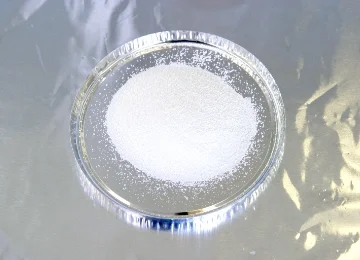
Our range of granulates consists of zeolite compounds (ZC), premixes and easily dissolvable dried silicates DRYSIL®. Zeolite compounds (ZC) and premixes, as well as easily dissolvable dried silicates DRYSIL® are primarily used in the production of detergents.
Dried silicates can be produced in powder or compact form, and are also used in the foundry industry and in the production of refractory materials, where they are used as thermostable binders.
Properties of Granulates
- High purity: the Al₂O₃ content typically exceeds 99%.
- High hardness: comparable to corundum (9 on the Mohs hardness scale), which makes it ideal for abrasive applications.
- Thermal stability: withstands extremely high temperatures, making it ideal for refractory materials.
- Chemical inertness: resistant to acids and bases, ensuring a long lifetime in harsh environments.
- Controlled particle size: available in different sizes for specific applications.
- Controlled specific surface area: can be adjusted to improve reactivity or inertness.
Refractory materials
Dried silicates DRYSIL® are used as binders in refractory materials. They are added to sand, fireclay, alumina, corundum, etc.
Learn more
Detergents
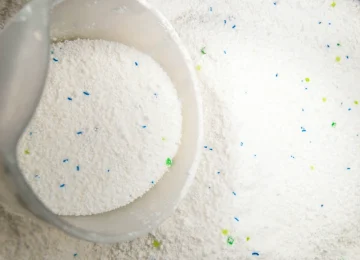
Zeolites are used in the production of washing powder in the tower drying (zeolite powder) and dry mixing (zeolite compound) processes. Silkem offers compact granules (premixes) and dried silicates DRYSIL® in different bulk densities for this production process.
Learn more
Dried Silicates DRYSIL®
| Type of Product | 120G | 520P | 820C | 526P | 826C | 533P | 833C | |
|---|---|---|---|---|---|---|---|---|
| Old name | NADIS 100G | NADIS 500 | ||||||
| Na2O | % | 26 ± 2 | 26 ± 2 | 22 ± 2 | 19 ± 2 | |||
| SiO2 | % | 55 ± 3 | 54 ± 3 | 53 ± 3 | 57 ± 3 | 63 ± 3 | ||
| M (Molar ratio; SiO2/ Na2O) | % | 2.1 ± 0.1 | 2.66 ± 0.05 | 3.35 ± 0.15 | ||||
| Loss on ignition (LOI) (1h / 800°C) | % | 16 ± 3 | 20 ± 3 | 19 ± 3 | 18 ± 3 | 20 ± 3 | ||
| Bulk density | g/l | 110 ± 25 | 520 ± 80 | 800 ± 100 | 520 ± 80 | 750 ± 100 | 520 ± 80 | 800 ± 100 |
| Average Particle Size d50 | µm | 500 ± 100 | 100 ± 50 | 800 ± 200 | 100 ± 50 | 800 ± 200 | 100 ± 50 | 800 ± 200 |
The DRYSIL® brand includes a range of soluble dried silicates in different molar ratios, bulk densities and forms (powder, compacted granulate). Dried silicates DRYSIL® are primarily used as binders in refractory materials such as sand, fireclay, alumina, and corundum. They can also be used as an ingredient in dishwashing powder. Compacted silicates are mainly used for this purpose. Sodium silicate can be produced with a bulk density ranging from 100 to 800 g/l, a special property that enables the ballooning effect, which can be controlled by adjusting the production conditions. This property also allows us to produce DRYSIL® 120G, which has a bulk density of around 100 g/l, and is used to adjust the bulk density of washing powders. The bulk density of washing powders must be consistent to ensure that the volume of detergent in each bag or box remains more or less the same. However, as the components originate from different sources, their bulk density and price vary. To prevent any variation in the bulk density of the final detergent, corrective additives such as DRYSIL® 120G are used. Otherwise, if customers buy a 5 kg bag that is smaller than the others, they might feel that they got less, which could lead to dissatisfaction and mistrust.
DRYSIL® 520P is the complete opposite, and while it is chemically identical to DRYSIL® 120G, it is produced under different production parameters and has a bulk density of around 550 g/l. This allows it to mix better with heavier components, such as sand, to produce casting mold compounds. Attempting to use sand with DRYSIL® 120G, which has a bulk density that is five times lower, would result in the segregation of components and inhomogeneous mixing due to the significant difference in bulk densities. Consequently, the binder would not be distributed evenly throughout the mold, which could lead to cracking, particularly in areas with less binder. DRYSIL® also has good refractory properties and is flame retardant. At elevated temperatures, dried silicates balloon, causing the structures in which they are contained to stiffen. For sands and concretes, this means that they do not collapse in the event of a fire, which is an exceptional quality for a material.
Premixes
| Type of Product | A1 | A2 | B2 | B3 | B4 | D20 | |
|---|---|---|---|---|---|---|---|
| Na-DBS | % | 18 ± 1 | 16 ± 1 | 10 ± 0.5 | 8 ± 0.5 | – | 20 ± 2 |
| Na-Soap | % | – | – | – | 3 ± 0.1 | 10 ± 1 | – |
| Na-Disilicate | % | 14 ± 1 | 16 ± 2 | 6 ± 1 | 5 ± 0.5 | 12 ± 1 | 78 ± 3 |
| Zeolite (lutro) | % | – | – | 40 ± 3 | 72 ± 3 | 20 ± 3 | – |
| CMC-liquid | % | – | – | – | – | 5 ± 0.1 | – |
| Na-Copolymer | % | – | – | 2 ± 0.1 | – | – | – |
| Na2SO4 | % | 67 ± 3 | 40 ± 3 | 11 ± 1 | 50 ± 3 | – | |
| Water | do 100 % | ||||||
| Bulk density | g/l | 350 ± 50 | 300 ± 50 | 400 ± 50 | 250 ± 50 | 200 ± 50 | |
| Average Particle Size d50 | µm | 350 ± 100 | 450 ± 50 | ||||
Premixes are compact granulates containing several active ingredients and are designed for the production of dry-mixed detergent powders. Zeolite (B) and silicate (A) premixes contain active ingredients (anionic and non-ionic surfactants, soaps and fatty acids) and functional additives (copolymer, CMC, phosphonate, Na2SO4, etc.). The premixes have a lower bulk density than the compounds due to the anionic surfactants giving them a ballooning effect, which results in a lighter material, typical of conventional washing powders.
What sets premix B4 apart is that all of its components are sustainably sourced and not derived from oil.
Premix D20 has the lowest bulk density, and contains a relatively high proportion of sodium silicate or water glass.
We can adapt the composition of premixes and compounds to customers’ wishes and needs, adjusting the components as well as the drying conditions.
Zeolite Compounds
| Type of Product | ZC1 | ZC2 | ZC3 | ZC6 | ZC9 | ||
|---|---|---|---|---|---|---|---|
| Zeolite 4A | % | 92 ± 3 | 87 ± 2 | 94 ± 2 | 96 ± 3 | 89 ± 3 | |
| Copolimer | % | – | 4.5 ± 1 | – | 2 ± 0.5 | 9.3 ± 0.3 | |
| Nonionic Tenzide | % | 2.5 ± 0.5 | – | ||||
| Na2SO4 | % | 2 ± 0.5 | 4 ± 0.5 | 3 ± 0.5 | – | ||
| CMC | % | 2 ± 0.1 | – | 1.5 ± 0.1 | – | ||
| Phosphonate salt | % | – | 0.7 ± 0.1 | – | |||
| Water | % | Rest to 100 | |||||
| Bulk Density | [g/l] | 530 ± 50 | 550 ± 50 | 560 ± 50 | 570 ± 50 | ||
| Calcium ion exchange capacity | [mg CaO / g anhydrous] | min. 160 | |||||
| Absorption No. | [g/100g] | 55 ± 5 | 50 ± 5 | 53 ± 5 | 52 ±5 | 53 ± 5 | |
| pH (1% Suspension) | 11 ± 0.5 | ||||||
| Average Particle Size d50 | µm | 350 ± 50 | |||||
| – 100 microns | [%] | max. 3 | max. 5 | max. 3 | |||
The main ingredient in zeolite compounds is zeolite 4A, a water softener (builder), which reacts with calcium ions (Ca2+) in water, exchanging them for sodium ions (Na+) from the zeolite. This softens the water, enabling the active components to perform more effectively. A similar role of calcium (Ca) ion exchange is played by the copolymer, which has even better magnesium (Mg) ion exchange and good binding properties (cohesion), which means it binds dust particles to form a granulate. CMC has the same function as well as preventing the removed dirt from settling back onto the fabric (anti-redeposition). This is important because suspending dirt particles in the washing water enables them to be rinsed away in the wastewater; otherwise, they would settle on the fabric. Phosphonate is a stabilizer, while sodium sulphate (Na2SO4) is an additive that improves the granulate structure.