

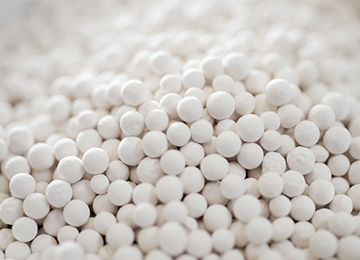
Tabular alumina ALFA TAB® is an alpha (α) aluminum oxide(α-Al2O3) product obtained by sintering specially prepared calcined alumina. It consists of large, well-defined α-Al2O3 crystals with an elongated, hexagonal shape that resembles a tablet, hence the name tabular alumina.
Production of Tabular alumina ALFA TAB®
Silkem has a long history of producing tabular alumina, dating back to the beginning of the millennium. We are constantly developing our production processes and upgrading our technology, as well as expanding our production capacities. Achieving the high quality of tabular alumina ALFA TAB® for the most exacting applications requires a stable raw material that is suitably prepared for further processing, regular and precise control of process parameters, and a stable production process.
Our technological capabilities, which are largely the result of our own research and development, give us an additional advantage, allowing us to adapt the quality of our tabular alumina ALFA TAB® to meet the most demanding product requirements of our customers. We keep our promise to deliver excellence by maintaining strict quality control at every stage of the production process.
α-Al2O3 is the only thermodynamically stable form of aluminum oxide. Another name for it that is mostly used in geology is corundum, which is found naturally in igneous and metamorphic rocks.
Properties of Tabular alumina ALFA TAB®
- high melting point (around 2050 °C),
- good thermal shock resistance,
- chemical inertness,
- high hardness (9 on the Mohs scale),
- abrasion resistance,
- mechanical resistance,
- good thermal conductivity,
- good electrical resistivity,
- low thermal shrinkage.
During sintering, the alumina crystals combine to form larger crystals, giving tabular alumina a more solid structure and its distinctive properties. The shrinkage that occurs when the crystals combine creates a homogeneous crystalline structure with low porosity, resulting in a product with a high specific density (at least 3.5 g/cm3). The grain size of tabular alumina ALFA TAB® ranges from 20 mm to below 0.020 mm, and is obtained through mechanical processes of crushing, sieving and grinding.
The preparation of the feedstock, additional processing and use of appropriate additives enable the production of low-alkaline tabular alumina ALFA TAB® 06, which is used in the most exacting applications, where exceptional purity (>99%) is required, in particular low content of sodium as the primary impurity.
The refractory industry is the largest single user of tabular alumina, accounting for around 90% of all global production. The remainder is used in the modular casting industry, the ceramics industry and the petrochemical industry. It is also used as a catalyst support in catalysis, for aluminum filtration and as an additive in epoxy resins.
Refractory Materials
Tabular alumina is one of the most commonly used oxides in the production of refractory materials, such as various types of concrete, bricks, monoliths, insulation materials and other products.
When it is combined with sintered spinels SP67, SP78 and SP90, refractory materials with superior performance can be produced at a lower cost. One of its most important applications is in the production of steel for sliding gates. Other applications include the production of refractory bricks for the cladding of foundry furnaces, covers, plugs and blocks. Tabular alumina ALFA TAB® of all grain sizes, from 20 to below 0.020 mm, is used in the production of refractory materials.
Learn more
Investment Casting
The properties of low-alkaline tabular alumina ALFA TAB® 06, especially their low impurity content, give it an advantage in applications in the foundry industry, especially in the most demanding modular casting processes.
Learn more
Ceramics
Tabular alumina’s thermostability, electrical resistivity, hardness, high melting point, low impurity content and chemical resistance mean it has a wide range of applications in the ceramics industry.
Ceramic tubes are mainly produced using tabular alumina with a grain size of 0–0.3 mm.
Learn more
Petrochemical industry
Thanks to its excellent properties, such as its chemical resistance and thermostability, tabular alumina can be used even in processes involving very harsh conditions.
Epoxy resins
Adding alumina to epoxy resins improves the material’s mechanical properties, such as hardness and abrasion resistance, as well as its thermal conductivity and dielectric properties.
Aluminum filtration
Tabular alumina is used as a filter in aluminum production.
We produce a wide range of products for specific applications using tabular alumina ALFA TAB®, employing processes such as crushing, grinding, mechanical and magnetic separation, and mixing and homogenization.
Tabular alumina ALFA TAB® is characterized by its high thermostability, high density, low water absorption, chemical inertness, corrosion resistance, hardness, thermal conductivity, electrical resistivity, abrasion resistance, and resistance to thermal and mechanical shocks.
| Chemical Composition (%) | ALFA TAB® 06 (Typical) | ALFA TAB® 30 (Typical) |
|---|---|---|
| Al2O3 | 99.5 | 99.5 |
| Fe2O3 | 0.08 | 0.08 |
| SiO2 | 0.04 | 0.04 |
| Na2O (Total) | 0.04 | 0.3 |
| CaO | 0.02 | 0.02 |
| FeMagnetic1 | ≤ 0.0251 | ≤ 0.0251 |
1 Also possible Fe Magnetic ≤ 0,007 – (LI)
| Physical Characteristics | Typical | Min | Max | |
|---|---|---|---|---|
| Bulk specific gravity2 | (g/m3) | 3.55 | 3.5 | |
| Apparent porosity | (%) | 4 | 5 | |
| Water absorption | (%) | 1.5 | 2 |
2 Bulk density also possible: 3.6 – 3.7 g/cm3
Standard Grain Sizes3
| (mm) | (mesh) | (mm) | (mesh) | |
|---|---|---|---|---|
| 0-6 | -1/4 | CD Balls | / | |
| 0-3 | -6 | 6-12 | 1/2-1/4 | |
| 0-2 | -8 | 3-6 | 3-6 | |
| 0-1 | -14 | 2-6 | 1/4-8 | |
| 0-0.5/0.6 | -28 | 2-3 | 6-8 | |
| 0-0.3 | -48 | 1-3 | 6-14 | |
| 0-0.2 | -100 | 1-2 | 8-14 | |
| 0-0.045 | -325 | 0.5/0.5-1 | 14-28 | |
| 0-0.020 | -635 | 0.3-0.6 | 28-48 |
3 other grain sizes also possible