

The basic function of detergents (washing powders) is to remove dirt from clothes during the washing process. This definition is rather simple, however the processes underneath are quite complex, with each component adding a certain quality. It is thus not surprising that washing powders contain between 15 and 20 different components.
Essentially, the first stage of washing involves removing stains, mainly grease, from the fabric, and the second stage ensures that the dirt particles are not redeposited onto the fabric, but remain suspended in the water to allow for effective rinsing.
Zeolites and dried disilicates are used in the production of washing powder in a dry mixing process. Silkem offers compact granules (premixes and zeolite compounds) and dried silicates DRYSIL® in different bulk weights for this process.
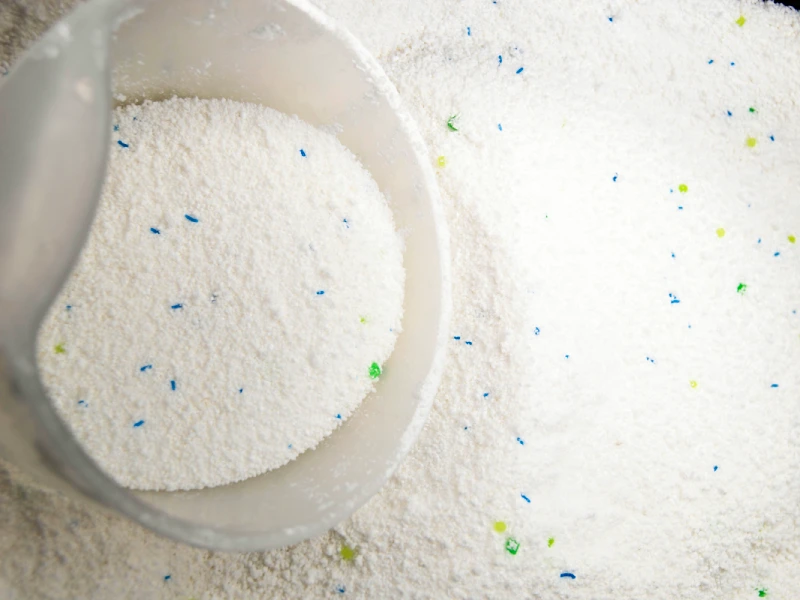
Active ingredients in washing powders
Silkem produces zeolite compounds and premixes, as well as dried silicates DRYSIL® for application in the dry mixing of washing powders. These products are characterized by their excellent flowability, low dust content, and hard granules that dissolve quickly in water.
Due to their outstanding ion-exchange properties and their benign impact on people and the environment, zeolites emerged as a suitable replacement for phosphates in the 1980s. This is also why zeolites are still found in washing powders 50 years later.
Zeolites in washing powders soften water through ion exchange, because the sodium in the zeolite can replace the calcium and magnesium in the water that cause hardness. Hard water can damage washing machine heaters, and free calcium (Ca) and magnesium (Mg) ions also bind with detergent’s active ingredients. This means that prior ion exchange is essential to ensure the optimal performance of the active ingredients in washing powders. Due to their extremely large active surface area, zeolites can also absorb large quantities of liquid ingredients added to the detergent (non-ionic surfactants, fragrances, enzymes, etc.). This is why zeolites are known as builders in detergents.
In addition to these, detergents also contain active ingredients, such as:
(perborate and percarbonate; bleaches also have a disinfectant effect)
The advantage of zeolite compounds is that they allow for a higher bulk density and greater compactness of the detergent, which is a prerequisite for producing a stable product using the dry mixing process.
In addition to carriers (zeolites, silicates and sodium sulphates), premixes may also contain active ingredients in alkaline form (fatty acids and DBSK). Adding a copolymer and water glass can improve the calcium and magnesium capacities of the final product. It is also important as an additive (binder) for achieving product compactness. This means that it facilitates the formation of grains or granules which have a significantly better flowability than the powder.
Silkem’s standard premixes also include various combinations of the aforementioned ingredients, to which special components can be added according to the customer’s requirements or formula, such as non-ionic surfactants, CMC, anti-foaming agents, phosphonates, carbonates and other ingredients, as shown in the tables.
Silkem’s DRYSIL® brand encompasses a wide range of dried silicates, which are used as binders, builders and bulking agents in washing powders. Active substances (such as DBSK and carbonate) can be added to DRYSIL® dried silicates.
In addition to standard household laundry detergents, there are also special detergents (for hospitals, breweries, dairies, etc.), dishwashing detergents, car cleaning products and other specialized products. Most of these also contain zeolites or sodium disilicates. The trend of growing use of liquid detergents has slowed down, as conventional washing powders are more effective in fighting microbes in terms of hygiene and disinfection.
| Product group | Applications | Effect |
|---|---|---|
| Zeolites | Washing powder production with spray drying | Water softening – Absorption of active ingredients |
| Premixes | Washing powder production with dry mixing | Water softening – Absorption of active ingredients – Bulk density regulation |
| Zeolite Compounds | Washing powder production with dry mixing | Water softening – Absorption of active ingredients – Bulk density regulation |
| Dried Silicates DRYSIL® | Production of dishwasher tablets – Washing powder production with dry mixing | Bulk density regulation – Buffering properties – Corrosion inhibitor |